By Dr. Sadik Omairey, Founder of NmeX Non-metallic Engineers Exchange
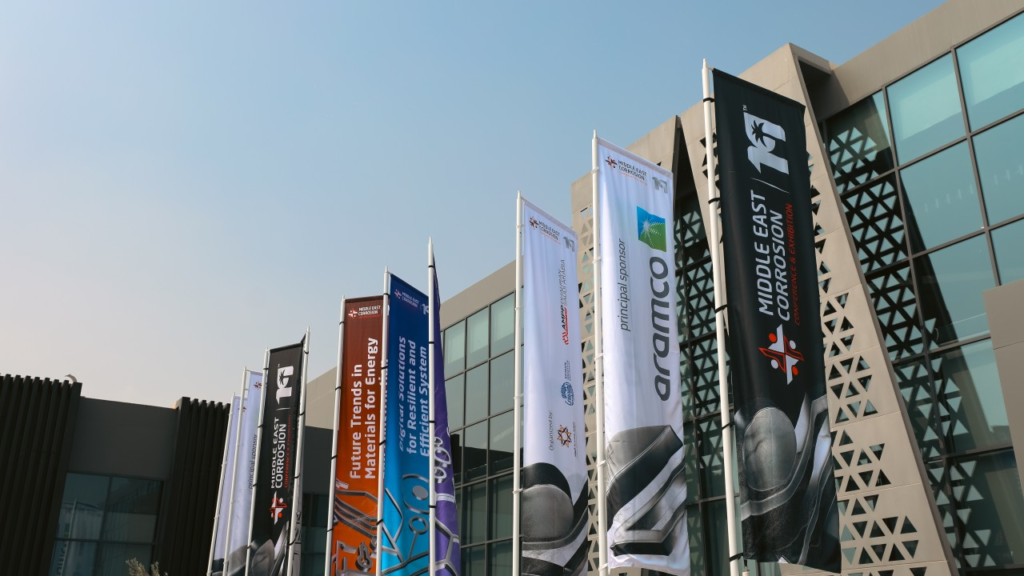
When I arrived at Dhahran Expo for 19th Middle East Corrosion Conference (MECC19), it was immediately clear that this was not “just another” event. The scale of the venue, the quality of the exhibition stands, the technical depth of the programme and the warmth of the welcome all pointed to the same conclusion: MECC19 has become one of the key global stages where the future of materials, and particularly non-metallics, is being actively shaped.
The Dhahran Expo | معارض الظهران itself played a big role in that impression. The halls were generous and well laid out, the exhibition area felt open and easy to navigate, and the transition from technical sessions to networking spaces was seamless. Even simple things, good food, plenty of places to sit and talk, and a well-managed flow of people, made it easy to focus on what mattered: learning, sharing and connecting. The hospitality was exactly what you’d expect from Saudi Arabia at its best: warm, efficient and genuinely welcoming.
People First: Conversations that Set the Tone
Before diving into the technical sessions, the conference started for me in the way the best events often do: with conversations.
One of the first people I met was Mike O’Brien from Syensqo, someone I’ve known and respected for a long time. Mike is one of those rare combinations of technical depth, humility and genuine supportiveness. Catching up with him felt like continuing a long, ongoing conversation about where composites should be going and what’s still missing in their deployment on metallic systems. This time, the discussion expanded with the presence of his colleague, Sergio Detoie Cardoso Martins, Head of Energy, Composite Materials at Syensqo. Together, we talked about the “missing loop” between what composites can do in principle and how they are actually being applied in the field, particularly in demanding energy environments. It was a good reminder that even in a conference full of new technologies, relationships and open technical dialogue remain central.

That theme of connection came back again in my discussions with the JEC team, Raheel Mohammad and Luke Gee. We reflected on the success of their first JEC Forum in Saudi Arabia and the plans for a second forum in 2026, at a time when composite manufacturing capacity in the Kingdom is accelerating. Their presence at MECC19 felt symbolic: the global composites community is no longer looking at the region from a distance; it is beginning to root itself here, in parallel with the growth of local manufacturing and innovation.

I also had the opportunity to catch up with Ben Davies, Programme Manager for Energy at The National Composites Centre (NCC). We discussed the national and international directions NCC is actively pursuing in the energy sector. Our conversation opened the door to potential future collaboration and highlighted the growing role NCC is playing in shaping the next generation of composite and non-metallic solutions.
It was also a pleasure to reconnect with colleagues and friends from Future Pipe Industries, including Jaison Joseph and Mazen Al Mawla . We discussed some of their latest developments, ongoing projects and areas where future collaboration could be mutually beneficial. It is always encouraging to see established companies actively advancing non-metallic technologies and exploring new opportunities in the region.

Another corner of the exhibition where I felt very at home was the stand for Graphene Innovations Manchester. It was good to meet friends and colleagues like Dr Vivek Koncherry , Lewis Barker and Pam Cowen Wright MIRP CertRP and to hear about their latest work on graphene and other 2D materials. The range of applications they are exploring, from graphene-enhanced concrete and rubber to lightweight poles, reinforced the idea that non-metallic innovation is not confined to pipes and tanks. It spans structural materials, functional surfaces, sensing layers and completely new design spaces. Vivek’s presentation on defence applications of graphene and 2D materials, including how small additions of graphene can significantly enhance concrete performance, fitted perfectly into the broader MECC19 narrative: how do we make materials work harder, smarter and longer in harsh environments?

Advances in Non-Metallic and Composite Pipeline Technologies
If one thread ran strongly through my MECC19 experience, it was the evolution of pipeline technology. A large part of the conference, for me, revolved around the different ways companies are re imagining energy infrastructure with non-metallic systems.
A particularly interesting discussion was with Hassan Bu Khamseen from NOV. Most of the industry is familiar with NOV’s rigid RTR solutions, but here the focus was on something more unusual: a flexible pipe system that uses a thermoset reinforcement rather than the more common thermoplastic approach. The concept is elegant. The pipe maintains flexibility even though the reinforcement is a thermoset, while a thermoplastic liner and outer jacket provide protection and are bonded to the reinforcement through a tie layer. The connector design is equally clever: threaded rather than crimped or swaged, avoiding plastic deformation and enabling the end fitting to be opened and reused. It is a small but important example of how thoughtful mechanical design can add practicality and sustainability to non-metallic systems.

That sense of careful, applied engineering was also very present in the sessions delivered by NOV and Novel Non-Metallic Solutions. One of the standout presentations was by Adel Badghaish, PhD, VP for Business Development at NOV. He walked us through the story of how non-metallics have been developed and deployed in Saudi aramco: from early pilots, through structured trials, to large-scale applications. A particularly valuable part of his talk was the account of collaboration with Petroleum Development Oman, and how shared experience between organisations and countries accelerated learning and reduced risk. The message was clear: deploying non-metallics successfully is not simply a matter of buying a new product; it requires awareness, correct deployment strategies, operator training and a partnership mindset between suppliers and asset owners.

Novel Non-Metallic Solutions, the non-metallic-focused joint venture between Aramco and Baker Hughes, continued this theme with a series of excellent presentations on downhole spoolable TCP solutions. Omar Elshamy, PhD presented on the challenges and future direction of the first spoolable carbon fibre TCP tubing for downhole applications. His talk combined technical detail with a very clear articulation of value: significantly lower emissions compared with conventional metallic tubing, the potential for lifetimes on the order of two decades rather than just a few years, and a step change in deployment speed and logistics. He also did not shy away from the engineering challenges: designing for high pressure and high temperature, managing composite behaviour over long-term loading, and ensuring reliability under demanding operational envelopes.

Complementing that, Ahmed AlAdawy, PhD spoke about the multidisciplinary development effort behind these downhole TCP systems. What came across strongly was that this is not just a materials problem or a mechanical problem; it is a systems problem that sits at the intersection of design, manufacturing, testing, operations and standards. TCP in this context is not a niche product; it is a serious contender to become a mainstream option for downhole tubing, provided the development and qualification continue with the same rigour we saw in their presentations.

On the topic of downhole tubing, Western Falcon Energy Services (formerly Polycore Tubular Linings) brought yet another angle to the pipeline story with their thermoplastic-lined metallic tubing. Their concept, presented by Jeff Schell, is to extend the life of conventional steel tubing by providing an internal thermoplastic liner that resists corrosion and wear, particularly in downhole applications. Jeff’s presentation on how these lined systems are installed, reused and operated illustrated a powerful principle: non-metallics are not only about replacing metals, but also about protecting and enhancing them.

Another memorable presentation related to pipeline technology came from Tanner Morgan of FlexSteel Pipe – A Cactus Company. His talk on steel-reinforced thermoplastic pipe for sour service was a good example of how “non-metallic” does not mean “no metal at all”, and how that hybridisation must be approached carefully. Tanner discussed in detail the challenges of using steel reinforcement in sour environments, particularly the risks of hydrogen-induced cracking (HIC) and sulphide stress cracking (SSC). He presented test results showing how conventional reinforcement materials can be compromised in sour conditions and how they developed a new grade of steel tailored for sour-service reinforcement. The level of testing and qualification behind this work was impressive and reinforced a point that appeared repeatedly throughout MECC19: whether a system is metallic, non-metallic or hybrid, understanding and designing for the environment is non-negotiable.

Strategy and Vision: Aramco’s Non-Metallic Roadmap
Pipeline technology and system design inevitably lead to strategy, and one of the talks that stitched many of these threads together was delivered by Hamad Alazzaz, MLA-I from Aramco. His presentation, “Pave the Way to a New Era of Engineering Materials”, offered a clear timeline of the company’s non-metallic journey, beginning with early RTP adoption in 2004, moving through RTR applications, and evolving into sour-service RTP and more advanced solutions.

What I appreciated about his talk was the structured way he articulated the strategy: identifying and maximising the use of non-metallic products, supporting new technologies, expanding product envelopes, qualifying more vendors, certifying contractors, and investing in awareness and training. It was not just about technology; it was about building an ecosystem where non-metallics are understood, trusted and properly deployed.
Understanding Materials Deeply: Permeation, Qualification and Realistic Testing
One of the strengths of MECC19 was the level of technical detail in presentations related to thermoplastics and their qualification. A pair of complementary presentations by aramco‘s Abderrazak Traidia and Amir Shamsa from TWI stood out. Their work on full-scale permeation testing for thermoplastic pipes demonstrated how conventional laboratory methods can find it challenging to capture the real in-service behaviour of FCPs and related systems. Using actual pipe sections rather than small coupons may seem like a simple idea, but it brings a level of realism and accuracy that is essential for hydrocarbon transport and future energy applications.

Abderrazak Traidia also delivered another talk, this time Aramco’s work with Flexpipe, where he challenged the limitations of traditional test methods and introduced the concept of a more realistic in-situ point-shear test for polymer qualification. These discussions reinforced a core truth: the move to non-metallics is not just a shift in materials, it is a shift in how we test, qualify and understand materials in context.

Learning from Failure: SABIC’s Underground FRP Experience
Among the most practical and eye-opening presentations at the event was delivered by Anas Alghamdi from SABIC ,who walked through lessons learned from chronic failures in underground FRP firewater lines. His talk was refreshingly honest and highly educational.
The failures he presented were not inherent to FRP systems, they were a result of incorrect practices: overpressure events, poor backfilling, rerouting under pipe racks, exceeding design envelopes, or insufficient inspection. In other words, failures were symptoms of misuse, not material shortcomings.

Eng. Anas summarised the key learnings into actionable points: perform surge analysis, respect design limits, improve compaction practices, qualify repair teams, inspect regularly, and assess FRP lines beyond 15 years of service. His presentation served as a reminder that deploying non-metallics successfully requires good engineering and good discipline, just as much as good materials.
New Entrants and Intelligent Systems
MECC19 was also a good place to see newer or less familiar names entering the non-metallic space with serious intent.
Muren Arabia for Energy, for instance, displayed an extensive range of non-metallic products including thermoplastic composite pipes and “intelligent” composite coil lines with integrated heating wires, power conductors and signal lines embedded in the thermoplastic structure. Speaking with Vinesh Vijayaraghavan, their General Manager, and Zou, the Deputy General Manager, it was clear that they are not just selling products; they are planning for regional presence and long-term deployment in the Middle East. The combination of advanced pipe technology with embedded functionality is exactly the sort of integration that could define the next generation of pipeline systems.

From China, companies like ZTOC and ZYfire Pipes Manufacturing Ltd showcased a remarkably wide portfolio of flexible and composite pipes, RTP, TCP and flexible risers with different reinforcement options. Their stands were a reminder that the global supply landscape for non-metallics is broadening quickly, with capabilities developing in multiple regions in parallel.

Digitalisation Meets Composites: ENERCOMP and the GRP Pipeline Digital Twin
A highlight in this space was the ENERCOMP Technology Consortium booth, an initiative between Aramco and KAUST and lead by Gilles Lubineau, where my friend and former colleague Aldyandra Hami Seno walked me through their live demonstration of a GRP pipeline digital twin. They had embedded sensors along a GRP line to detect ground movement, strain, and any behaviour that might influence joint integrity or pipe performance.

Seeing the combined use of non-metallic structures with sensing and analytics felt like a preview of what “smart pipelines” could mean for the region. It was also personally meaningful to meet Aldy again brought back memories of our work together, and we even found time to enjoy an evening out in the city, catching up properly.
Composite Repairs: A Quiet Revolution
Another topic that repeatedly surfaced across the exhibition was composite repair. What struck me is how mature and sophisticated this field has become. Several companies showcased different philosophies and repair approaches, but the message was consistent: composites aren’t just a replacement for steel, they are increasingly part of how we extend the life of steel systems.
At the forefront was CSNRI Composites, with an excellent presentation by Stuart McKay on composite repair wraps for steel pipeline crack repair. His talk served as a reminder that rehabilitation can be as impactful as new construction when it comes to asset management.

Complementing that were demonstrations from Awtada for Equipment Maintenance Company, who also presented robust composite repair systems for steel infrastructure.

On the other hand, Inductosense‘s Tim Coope showcased their clever ultrasonic sensor system capable of detecting corrosion even below composite wraps, including conductive carbon fibre wraps. This compatibility with carbon fibre repairs is an important capability, given how widely carbon can now be used for reinforcement.

The collection of companies working in this space hinted at an important evolution: composite repairs are now seen not just as stop-gap measures, but as engineered, long-term solutions backed by testing, monitoring and qualification.
Valves, Fittings and Everything in Between
Another pleasant surprise came from Georg Fischer, whose presentation by Loris Mazzerbo made a compelling case for thermoplastic valves in heavy industrial environments. One of his demonstration images said everything without needing words: three large thermoplastic valves held on one side of a balance, matched against a single steel pipe section on the other, and still lighter.

The advantages he discussed, corrosion resistance, reduced maintenance, ease of installation, and longer service life, highlight how the move to non-metallics is not limited to pipelines. Entire systems, including valves and fittings, are being re imagined.
A separate but equally interesting discussion took place around NEXCEL: Nonmetallic Excellence and Innovation Center, NEXCEL was established in Beijing with the support of Aramco. The centre focuses on a wide spectrum of non-metallic technologies, including advanced composites and FRPs, construction chemicals, pavements, waterproofing, insulation systems, and several specialised applications. Their state-of-the-art facilities and research capability reflect Aramco’s long-term commitment to expanding non-metallic innovation globally, and the conversations provided a useful window into how China-based research is feeding into broader regional and international deployment strategies.
Ambition and New Concepts: Mobile Manufacturing Vision
Then there was Purapipe, represented by Lamjed Kefi, with a concept that immediately caught the imagination: mobile pipe manufacturing units capable of producing and installing corrosion-resistant pipeline directly along the route. Integrated NDT checks, sensing capabilities, and continuous installation, it is an ambitious, early-stage idea, but one that reflects the sort of bold thinking that pushes industries forward.

NmeX’s Contribution to MECC19: The Non-Metallic Pipe Selector Tool
It was also a privilege to contribute to the programme by presenting the progress of the NmeX Non-Metallic Pipe Selector Tool. In Dr. Sadik Omairey talk, we discussed the role of correct material selection and the reasons behind hesitation in adopting non-metallic systems. We emphasised how many challenges in design, operation and maintenance trace back to early decisions about materials, and how digital tools can help engineers navigate complexity, compare technologies and deploy non-metallics with confidence.

I also highlighted the mission of NmeX Non-metallic Engineers Exchange: supporting the global community of engineers and decision-makers working with non-metallic materials, creating tools, sharing knowledge and accelerating deployment. The engagement and feedback after the session were extremely positive, and I will share the recording link separately for those interested.
A Note of Appreciation and the Journey Beyond MECC19
Among the many valuable discussions during MECC19, I would like to acknowledge the excellent support from the chairs of my session, Mohammad Towhidul Bashar and Eng. Ahmed Al Otaibi. Their professionalism and organisation ensured the session ran smoothly, and I am particularly grateful to Mr. Ahmad for his warm welcome, constant support and genuine hospitality throughout the event. His readiness to assist, facilitate and engage made the experience both productive and enjoyable.

I also had the opportunity to spend meaningful time with Ahmed Alshammari from OSP | برنامج استدامة الطلب على البترول. Our conversations covered localisation, deployment challenges and future opportunities for non-metallic materials in the Kingdom. His clarity, openness and generous hosting added significant value to my time at the conference.
After MECC19 concluded, NmeX Non-metallic Engineers Exchange trip continued across the Kingdom, travelling to Jeddah and Mecca for Umrah, then to KAUST (King Abdullah University of Science and Technology) to visit my friend Aldyandra Hami Seno, before returning again to Dammam for the Composite and Non Metallic Expo 2025 (more details to follow). The sequence of events created a purposeful journey that connected technical engagement, cultural reflection and professional collaboration across different regions of Saudi Arabia.

These reflections capture only a portion of what MECC19 had to offer. I am certain there were many other valuable presentations, interactions and innovations that I could not cover here, but the overall experience was truly exceptional.