Dr. Sadik Omairey | Founder of NmeX Non-metallic Engineers Exchange
For years at AMI, the conversation around non-metallics has centred on proving performance, strength, temperature, pressure, qualification and testing. This year, the operators’ panel marked a clear shift away from that familiar ground. Sitting in the session, it became obvious very quickly that this was no longer a debate about whether non-metallics work. That question is largely settled. What unfolded instead was a far more revealing discussion about why, despite decades of successful deployment, non-metallics still struggle to move from “proven technology” to true default status in critical energy infrastructure.
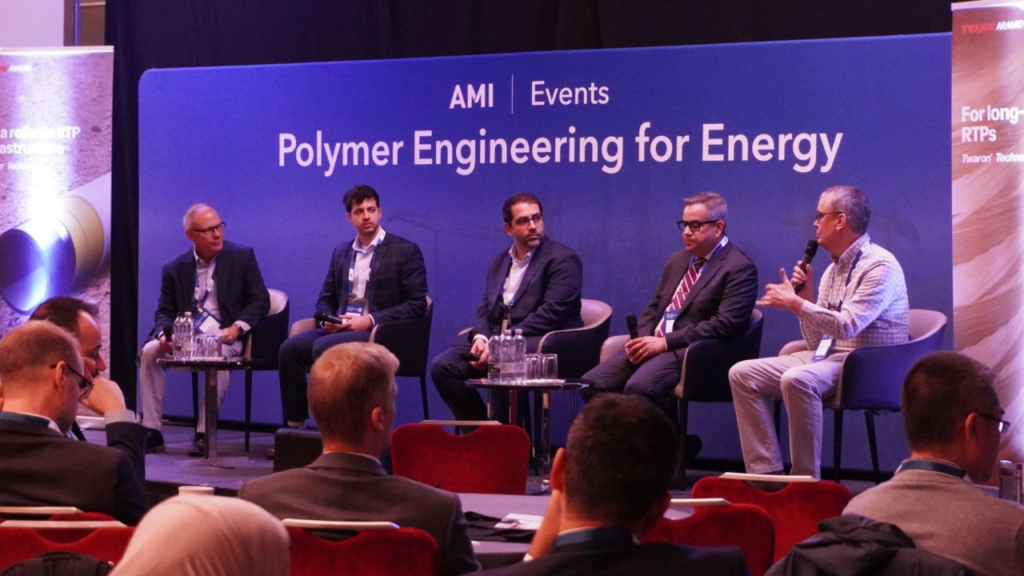
The discussion brought together senior non-metallic leaders from across the operator landscape, including Carlos Fernandez, PhD from ExxonMobil, Kostas Vatopoulos from Saudi aramco, Denis Melot from TotalEnergies, and Talen Sehgal from Chevron. What made the exchange particularly powerful was not just the technical depth, but the fact that all four speak from daily experience of approving, rejecting, qualifying, and defending non-metallic solutions inside some of the most risk-sensitive organisations in the world. The conversation was refreshingly practical, grounded not in theory, but in what actually survives internal gate reviews, waivers, audits, and failure investigations.

The debate is no longer about whether non-metallics work, it’s about why they still aren’t the default.
The discussion moved naturally toward CCUS, hydrogen, and the wider energy transition. Everyone in the room seemed aligned that CO₂, H₂, sour fluids and aggressive impurities are no longer future design cases, they are becoming standard operating environments. And yet, one uncomfortable truth hovered in the background: despite all the ambition around CCUS, there are still very few widely shared, trusted success stories for non-metallics in this space. Not because they do not exist, but because the data is fragmented, confidential, and rarely accessible to the engineers who actually need to design the next generation of assets. Without visibility of long-term performance, designers fall back on conservative assumptions, heavy safety factors, and ultimately familiar materials.
The problem is no longer performance; it’s the absence of shared proof
What followed was one of the most honest admissions of the session: CAPEX still dominates decision-making, even when everyone knows that lifecycle cost is the correct metric. Non-metallics continue to make economic sense over twenty or thirty years, yet projects are approved based on how tightly they meet a short-term capital budget. Engineers are rewarded for coming in under cost today, not for preventing corrosion failures fifteen years from now. The result is a systematic bias toward materials that look cheaper on day one, even when they are guaranteed to be more expensive over the life of the asset. Even when operators acknowledge the long-term benefits in theory, in practice many organisations still operate with a rigid separation between CAPEX and OPEX that makes true lifecycle optimisation extremely difficult.
Engineers are rewarded for coming in under cost today, not for preventing corrosion failures fifteen years from now. The result is a systematic bias toward materials that look cheaper on day one, even when they are guaranteed to be more expensive over the life of the asset.
The contrast between greenfield and brownfield projects also surfaced naturally. In new developments, there is at least some openness to integrating non-metallics from the beginning. In brownfields, however, resistance is far stronger. Existing specifications are metallic. Existing inspection philosophies are metallic. Fitness-for-service rules were written for steel. Contractors are set up for steel. Even when a non-metallic solution is technically superior, it must overcome layers of inherited practice and institutional memory. The decision is no longer just about engineering, it becomes about precedent, liability, and organisational comfort.
In brownfields, history is often a stronger material than engineering.

One of the most quietly important themes in the panel was not about materials at all, but about information. Again and again, the same frustration surfaced: engineers cannot design what they cannot calculate, and they cannot calculate what they cannot clearly see. The issue is no longer the absence of standards, it is the absence of consistent, standardised, and genuinely comparable product data that can be trusted across suppliers. What operators were really asking for was not disruption or novelty, but something far more fundamental: a common language for non-metallic products that enables true apples-to-apples comparison, transparent pressure–temperature envelopes, defensible permeation expectations, chemical limits, inspection assumptions, and credible long-term knock-down factors.
Engineers don’t design with brochures – they design with numbers.
What became clear is that the industry does not just need better materials; it needs to stop tolerating fragmented, opaque, and inconsistent ways of describing them. Without shared structure around how non-metallic products are defined, filtered, compared, and selected, every project is forced back to first principles. And every new engineer is condemned to repeat the same learning curve that the last one already paid for.
This is exactly the gap we are trying to close through NmeX and the Pipe Selector tool. Not by promoting any single supplier or product, but by structuring non-metallic pipe data in the way engineers actually need to work with it, through pressure and temperature envelopes, fluid types, chemistry, sour service conditions, and application boundaries. The aim is to move non-metallic selection away from opaque datasheets and disconnected catalogues, and into a neutral, comparable, filter-driven environment where engineers can see what fits their operating window before they ever reach a procurement stage. If non-metallics are to become default rather than exceptional, this kind of structured visibility has to exist long before detailed design begins.

Another thread that ran through the panel, sometimes explicitly and sometimes between the lines, was the role of people, or more precisely, the absence of non-metallic subject matter experts in key parts of the delivery chain. Offshore, this capability now exists almost by default. Onshore, it often does not. Many EPCs still rely entirely on metallurgical specialists whose careers, intuition, and inspection instincts are built around steel. When these engineers are asked to evaluate polymers and composites, the problem is not resistance, it is unfamiliarity. The questions they ask often come from a metallic mindset that simply does not map cleanly onto non-metallic behaviour.

This leads to a deeper issue than training courses alone can fix. Without embedded SMEs inside EPCs, non-metallics are forced to justify themselves repeatedly at every design gate, to every new reviewer, often using slightly different criteria each time. The result is fatigue, conservatism, and default reversion to steel simply because it is organisationally easier to defend. Even internally within operating companies, several voices acknowledged that awareness is uneven. Some teams use non-metallics as day-to-day baseline technology. Others still treat them as special cases.

The split between offshore and onshore environments made this human bottleneck even more visible. Offshore, non-metallics, particularly flexible pipe systems, are already part of the standard engineering vocabulary. Specialist contractors exist, operators are familiar with the technologies, and deployment follows relatively well-understood pathways. Onshore, however, the picture is very different. Here, EPCs often default to decades of metallurgical thinking, not out of stubbornness, but because that is the only framework they have been trained to operate within. When composites and polymers enter that space, they are judged through a metallic lens, where they rarely appear comfortable.
Offshore understands non-metallics – onshore is still translating them.
The long-running narrative of thermoplastics versus thermosets also emerged again, but this time with a notable lack of hostility. There was clear consensus that the real conversation is not about winners and losers, but about envelopes of use. Each material family brings strengths and limitations, and the challenge is not choice, it is clarity. The danger, more than anything, is that both families get blended together into one vague mental category labelled “non-metallic,” which makes meaningful selection almost impossible for non-specialists.
The real problem isn’t which non-metallic we choose – it’s that many still see only just one.
Perhaps the most emotionally charged part of the discussion came when the panel turned to inspection, failure, and trust. One speaker cut straight to the heart of it: this is not truly a technology problem, it is a trust problem. Engineers are not afraid of failure itself. They live with metallic failure every day. They understand it. They can monitor it. They can predict it. With non-metallics, that same intuitive failure map does not yet exist at scale. When someone asks how to UT a polymer pipe, what they are really asking is how to re-establish a sense of control that has been built over decades around steel.
Steel is trusted not because it doesn’t fail — but because its failure is familiar.
This naturally exposes one of the most unforgiving realities for emerging materials: a single visible failure can outweigh a hundred silent successes. Because the industry is still, in many places, arguing the case for non-metallics against a backdrop of decades of metallic familiarity, tolerance for visible failure is dramatically lower. That makes the selection of early pilot applications disproportionately important. Over-promising, even with good intent, does real damage not just to a product, but to confidence across entire material classes.

In new materials, one visible failure still outweighs a hundred quiet wins.
At the same time, the panel also confronted an uncomfortable double standard. Steel failures are quietly normalised. Leaks, corrosion, wall loss, inhibitor injection, replacement campaigns, these are accepted as part of standard operations. The industry is not afraid of failure in itself. It is afraid of unfamiliar failure. Several speakers framed this not as a technology gap, but as a communication and perception gap.

The panel did not expose doubt about whether non-metallics belong in the future energy system. That question now feels largely settled. What it exposed instead is that the systems of decision-making around them have not yet fully caught up with the reality of the materials themselves. The bottleneck is no longer tensile strength, temperature resistance, or chemical compatibility. It is confidence, comparability, competence, and culture.
The materials are ready, the decision structures are still learning how to trust them.
To conclude, we’d like to thank AMI for creating the space for such an open and thoughtful exchange, and for bringing together operators, material developers, suppliers and researchers in a way that allows these conversations to happen honestly and constructively. Special thanks to Harriet White and the wider AMI team for the invitation and for hosting such a well-run and highly valuable event. These are exactly the kinds of forums the industry needs more of.
